Friday, April 18, 2008

Jewish Community Experience/Project

Primary Actors
Liliana (ME) – Catholic Mexican 23 year old graduate student


Adam (Hebrew name: Abba) – Jewish 24 year old science writer than graduate student. Currently, my promised.


Reagent
El Amor between myself and Adam that after 4 years finally led to us becoming a couple on August 14, 2006.

Affected actors within the Jewish Community
Adam’s family, Rabbis, Adam’s high school friends, Adam’s NYC friends, Adam’s new friends in Michigan, Chabad family, Jewish community in general

Project/Life Experiences: Introduction of reagent into Jewish community

STORY/Results:
Before I broke into the Jewish community my boyfriend, Adam, was experiencing fear. Fear. Towards what I was told were such good and loving people didn’t make sense to me. However, I came to see the complexities and gravity of the situation.

Feelings towards INTERMARRIAGE: When Adam was 10 years old, his father pulled him and his little brother aside and made it very clear to them “You are to date only Jewish girls.”

When Adam, at age 24, pained but determined chose to date me, a Catholic girl, his parents then told him, “You are throwing away your Jewish identity.”
Identity? What does that mean? It would take me over a year to understand.

Monday, April 14, 2008

Prologue-- Why Liliana is integrating into the Jewish community.


So I went over somewhat superficially a little background on Judaism. I am not sure what your impression was from reading this but if I made things sound simple and easy they certainly have not been :(
You might be wondering why I decided to convert in the first place and enter into this new world and stretch not only my own boundaries but that of others as well...


In the picture: That's Adam. I fell for him about 5 years ago and we started dating a little over a year and a half ago. He's very Jewish and his family is too. We didn't start dating 5 years ago because I was not Jewish. Making the decision to convert took almost a year of both learning about Judaism and trying to understand why it was so important for Adam to marry someone who was Jewish. It was pretty crazy. Adam was stressed and confused, his family was very angry with him for dating a non-Jew which I found very difficult to understand especially having not ever felt like part of a community and certainly not tied to a community in any way. So I decided it would be best, because I love Adam and we both wanted to be together, for me to convert. For myself, it wasn't such a big change. Of course some religious people think I'm completely confused and lost but my whole faith basis just happens to be pretty consistent with almost any religion so switching from Catholicism to Judaism was just a matter of expressing my faith in a different way. And of course, in a way which I thought was good. But conversion is a long and tedious process. While you learn a lot it is time consuming and kind of uncomfortable since it feels like you are being judged. But aside from that, it has been an amazing experience becoming a part of this community. I'll try to sum it the process and story in the next few posts...

Sunday, April 13, 2008

Jewish Customs Part III -- Fashion

There are a few things that distinguishes a Jewish person from those around them. Like the way they dress. Not all Jews wear these things but quite a few do and so I thought I would talk about them a little.

First, there is the kippa. I bring this one up first because this is what my boyfriend wears everyday. As far as I know, there is no rule that requires one to wear a kippa but it has become a meaningful tradition to remind one of God's presence above them.

It's less common among women to wear kippas, at least in Orthodox Judaism but I won't get into the movements within Judaism here. In very traditional or observent groups, men also wear payos. This is done because in the Torah it says that one should not cut the hair on that part of the head. So it grows out very long. There are also Jewish men who just grow out their beards really long too. For women, the tradition has been to wear skirts. I heard someone in class saying she feels more comfortable in skirts because they are less revealing then pants and thus she can be more modest. There are certainly skirts that are not considered "modest" but one is to use their own judgment when wanting to be modest. Another practice for married women is to cover their hair either with a hat, scarf or even wig. These practices aren't really difficult for me because I have always been pretty modest...maybe even to the point of being ridiculous some might think since I almost always (except like once in my life) worn a big shirt over my bathing suit and as an adult don't even own a bathing suit. I just use a shirt and shorts...haha. The only thing is that it gets a little warm when i have on layers of clothes. And I am very "tomboyish" so wearing a skirt sometimes gets in the way. But it is nice anyway.

Friday, April 11, 2008

Jewish Customs Part II --The Day of Rest!

Then there is Shabbos! I'm really amazed by people who keep Shabbos. It is so much fun and really relaxing. I like having a day out of the week where you don't think about work at all and you hang out with a lot of other people who aren't thinking about it either. Because of all the specific rules it's hard for observant Jews to get around having to be together. I feel like this part of Judaism is what brings people together the most in a very consistent way. No driving, no electricity, no writing, ect. The closest I can do to do work is read and think but without being able to write anything down to remember these things, it really doesn't get me very far.

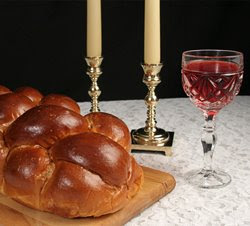
So I should explain where the rules for Shabbos come from. So a long long time ago, the Jewish people sat down and had to decide what doing work meant, this being because in the Torah God commanded the Jews to keep the Sabbath day holy or basically to not work. So the Jewish people at the time agreed that work would be defined by the 39 actions described in the Torah of the building of the temple. These included lighting fires, carrying things, ect. And for modern times, all these rules have to be made to fit the things that we do today. Some of the funnier ones include not ripping things on a seam, not turning lights on and off, and not biting your nails. Right before Shabbos starts one should light candles and say a blessing. There are also lots of different prayers that you do on Shabbos including Kiddush which you do over a glass of wine before starting your Shabbos meal. The meal is always prepared before Shabbos starts since it is a rule to not cook during Shabbos and it usually includes Challah which is a braided type of bread that is really yummy but can use other types of bread too. All these rules give Shabbos a certain spirit that makes it so much more different than any other day of the week.


My personal experience with Shabbos is mixed. While I love everything we do, especially when/if we sing, I find it difficult to keep Shabbos completely. It can be frustrating to other people who do not want to keep Shabbos (but who I am with on Shabbos) because I don't want to drive places. When I used to go to church it was a lot simpler since it was just one hour out of the day. So I would go and come back and could do whatever. But Shabbos is about 25 hours long and on the weekend when everyone else is off too and wants to go out and do things. This makes me a little sad because I do not want to distance myself from people who I love who are not Jewish but I am suddenly more burdensome for them because I am keeping what seems to them very strange practices. But I think and hope that they will come to love Shabbos too because there are so many things you can do on it like play boardgames and just sit around and talk or read or eat or sing. Or take walks together...


Description of Jewish Community

So now things are a bit different. I'm taking on these new, very specific practices that actually DO make me part of a community. I should talk a little bit about what exactly I do differently before I tell you how its affected my life...


So there is Kashrut which are the rules that govern food. I've started to notice that there are different levels of observance. "I keep Kosher" can mean a variety of different things but the main idea is to 'elevate' yourself by only eating certain types of foods i.e. making God first and food (or pleasure) second. This way they pleasure you enjoy is for God and thanks to God. Well that's my weird interpretation of it at least. Anyhow, the biggest rule is not to mix meat and milk. Being a vegetarian, this rule is not difficult for me. There are also rules about how to slaughter animals and which animals are not suitable for eating, like pigs and certain types of seafood.

One of the more modern ways of trying to regulate things is by putting symbols on packages that indicate whether a food is Kosher and whether it is dairy, meat, or parve (nuetral).
But just because something is not certified doesn't necessarily mean it's not kosher...it does, after all, cost money to certify things. This whole certification thing is pretty new too since before they didn't have the technology to be able to do this. But then there is the issue with Kosher dishes which does complicate things. You see, in the past the cookware that you used would many times absorb the flavor of foods and then this flavor would get transferred to other things that you cooked so to be very careful people started using different dishes for meats and milks. The rules get really complicated so I won't explain them here (and even if I tried I'd probably get them all wrong :P) but today people don't think that flavors get transferred and you should just wash your dishes really well and so some people don't separate and some do. Now this makes it difficult for just any restaurant to be Kosher. It would have to only serve meat or milk dishes and all the ingredients it used would have to be certified and none of it's cookware or dishes could have been previously used for whatever it is they don't serve there (meat or milk)...and i'm just simplifying things....i think...

So the results of trying to be an observant Jew I have come to see as this: for one thing I think it's neat because when you go out to eat, you must go to a Kosher restaurant which there aren't that many so you end up seeing the same people and you all have this bond that you choose to eat this type of food. Which is neat. However, the fact that you are "limited" to these restaurants and also 'limited' in accepting friend's invitations to have dinner at their place is a little frustrating. It makes things a little exclusive which, coming from a non-Jewish background, is troubling to me. I mean, if I really want to be strict in my observance I wouldn't be able to eat my own mother's home cooking :-/ However, at this point in my conversion that is not the case... and I hope that it won't be later either. But I probably should talk to my rabbi about it.

Food

Then there is Shabbos! I'm really amazed by people who keep Shabbos. It is so much fun and really relaxing. I like having a day out of the week where you don't think about work at all and you hang out with a lot of other people who aren't thinking about it either. Because of all the specific rules it's hard for observant Jews to get around having to be together. I feel like this part of Judaism is what brings people together the most in a very consistent way. No driving, no electricity, no writing, ect. The closest I can do to do work is read and think but without being able to write anything down to remember these things, it really doesn't get me very far. So I should explain where the rules for Shabbos come from. So a long long time ago, the Jewish people sat down and had to decide what doing work meant, this being because in the Torah God commanded the Jews to keep the Sabbath day holy or basically to not work. So the Jewish people at the time agreed that work would be defined by the 39 actions described in the Torah of the building of the temple. These included lighting fires, carrying things, ect. And for modern times, all these rules have to be made to fit the things that we do today. Some of the funnier ones include not ripping things on a seam, not turning lights on and off, and not biting your nails. Right before Shabbos starts one should light candles and say a blessing. There are also lots of different prayers that you do on Shabbos including Kiddush which you do over a glass of wine before starting your Shabbos meal. The meal is always prepared before Shabbos starts since it is a rule to not cook during Shabbos and it usually includes Challah which is a braided type of bread that is really yummy but can use other types of bread too. All these rules give Shabbos a certain spirit that makes it so much more different than any other day of the week.

My personal experience with Shabbos is mixed. While I love everything we do, especially when/if we sing, I find it difficult to keep Shabbos completely. It can be frustrating to other people who do not want to keep Shabbos (but who I am with on Shabbos) because I don't want to drive places. When I used to go to church it was a lot simpler since it was just one hour out of the day. So I would go and come back and could do whatever. But Shabbos is about 25 hours long and on the weekend when everyone else is off too and wants to go out and do things. This makes me a little sad because I do not want to distance myself from people who I love who are not Jewish but I am suddenly more burdensome for them because I am keeping what seems to them very strange practices. But I think and hope that they will come to love Shabbos too because there are so many things you can do on it like play boardgames and just sit around and talk or read or eat or sing. Or take walks together...


To Start -- Liliana

Documenting my experiences with the Jewish Community:

"Becoming part of a community" was a phrase I hardly understood the first time I was truly confronted by it. I remember, probably about a year ago, telling my Jewish boyfriend, Adam, how cool Judaism was and how I wanted to be a part of it to be able to share it with him but at the same time warning him that he should NOT expect me to really be a part of any community ever. "I've spent my whole life not feeling like part of a community and I don't see how that could change ever..." I said.

Today things are quite different. I feel like the same person but I certainly talk like a different one. "Community" has taken on a new role in my life. Both my personal experiences and my classroom experience (having chosen to take courses that really stress and analyze the importance of community) have been factors in this process. I have gone from observer to participant and to be completely honest its a little scary but also very fun.

Now it's a little late in the game but I thought I would try and write down a little of what I've been through on this journey up to this point. Let's start at the beginning of this year or at least close to it.


On January 23rd my first Jewish conversion class took place at 6:45pm in Manhattan. I was surprised to see that so many people were also following this path with me. I could hear jokes around the room of people telling stories about how people would ask them "Why in the world would you want to become Jewish, I mean it's one thing if you are born into it and have to deal with all the rules but why would you choose to take Judaism on on your own???"

People I knew had been telling me similar things since I was young ...even before I was even familiar with Judaism. However, when I was younger my "rules" or choice of actions weren't following any particular community structure, they were just personal choices that ended up making me a little outside of the communities I had around me.

So why would someone choose to do "restrict" their choices. Just to annoy other people and try and be counterculture? Just to give more meaning to their life by looking for something beyond what is meaningful to the people around them? It all seemed a little selfish. So I was conflicted with this paradox for awhile.

To quote my mother's response to my choices in life, she writes, "It does sound very selfish the desicion to convert to judaism. It is like throwing away all the freedom you were raised up with."

But I have always made choices that seem to "throw away" my freedom. Like not wanting to date anyone, not buying nice stuff, fasting, not going out hardly ever, being a vegetarian, quitting smoking, not wanting a car...in fact, not too long ago I had wanted to be a nun and going into any religious order automatically places upon you many restrictions. Now you probably think I sound like an ascetic or something. But I think the important question is whether you really think these rules are good for you and whoever you care for and whether you actually made the choice to follow them. Everyone has to choose the rules they live by even if their rule is to not follow any other rule. As far as the selfish thing goes....anyone can argue (and many people do) that whatever you do in life has selfish motives. But as you'll see later....I'm starting to understand this a bit differently.

Ok so I went on a bit of a tangent...but let me try and tie this in ....next post!